
Traje de Isabel II de España
Trajes de finales del siglo XIX
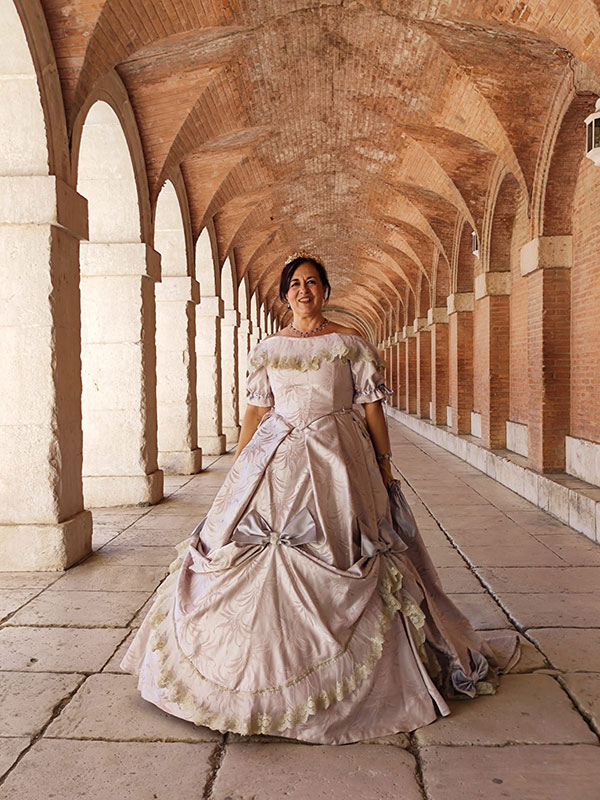
Dress inspired by paintings of the time.
This dress is made to recreate the historical character of Isabella II of Spain.
It has characteristic details of the period (1840-1870) such as the volume of the skirt, the bows, the ruffled decorations and the neckline revealing the shoulders.
The visual majesty of what we see transports us through history.
The fabrics used for this recreation are not as rich as those used in 1850 by royalty. Then a series of very valuable fabrics were used, such as Lyon silks, cashmere wools, furs, muslin, brocades, velvets, lace, lace trimmings, etc. For the recreation, in this case, I have used synthetic fabrics that make the dress more attractive but, at the same time, make it easier to clean.
The miriñaque that carries this costume is made with fine fabric and cancan rod. It is a hard and, at the same time, flexible rod that allows to maintain the skirts and petticoats with the desired volume. The body is fitted and has rods to maintain the shape.
The wardrobe of a lady of the time consisted of stockings, undershirt, breeches or pololos, miriñaque, petticoat, skirt or skirts, fitted body and, in the case of the winter period, capes or coats.
Juani MVS

Vestido inspirado en cuadros de la época.
Este vestido está confeccionado para recrear el personaje histórico de Isabel ll de España.
Tiene detalles característicos de la época (1840-1870) como son el volumen de la falda, los lazos, los decorados con volantes y el escote dejando ver los hombros.
La majestuosidad visual de lo que vemos nos transporta a través de la historia.
Los tejidos usados para esta recreación no son tan ricos como los utilizados en 1850 por la realeza. Entonces se usaban una serie de tejidos muy valiosos como sedas de Lyon, lanas de cachemira, pieles, muselina, brocados, terciopelos, encajes, puntillas, etc. Para la recreación, en este caso, he utilizado tejidos sintéticos que dan vistosidad al vestido pero que, a la vez, facilitan la limpieza del mismo.
El miriñaque que lleva este traje está hecho con tela fina y varilla de cancán. Es una varilla dura y, a la vez, flexible que permite mantener las faldas y enaguas con el volumen deseado. El cuerpo es entallado y lleva varillas para mantener la forma.
El vestuario de una dama de la época estaba constituido por medias, camisa interior, calzones o pololos, miriñaque, enaguas, falda o faldas, cuerpo entallado y, en el caso del periodo invernal, capas o abrigos.
Juani MVS
Enlaces de interés:
- https://es.m.wikipedia.org/wiki/Isabel_II_de_Espa%C3%B1a
- https://es.m.wikipedia.org/w/index.php?title=Miri%C3%B1aque&wprov=rarw1
- https://es.m.wikipedia.org/w/index.php?title=Ropa_interior_femenina&wprov=rarw1
- https://www.facebook.com/share/r/8i8ASTs1scJPzn5k
Volver al post Trajes de finales del siglo XIX ➢