
IES stands for Instituto de Educación Secundaria, something like Secondary Education School. We use the French word ‘Institute’. Our Secondary School was built in 1989. Mejorada was much smaller at the time. But the population increased and another bigger and newer secondary school was made. There are around 700 students. The other Secondary School is called ‘Los Olivos’ and students can study Vocational Training in it.
When students end the Primary School they come to study to the Secondary 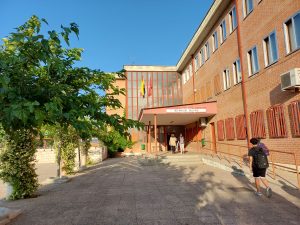 School or High School. When they come here, thery are 12 years old. They stay here for at least 4 years, until 4th of ESO (Educación Secundaria Obligatoria). The students are 15 or 16 years old. Until students are 16, education is compulsory in Spain.
Our Secondary School is a bilingual school. We have the subject of English language every day. Some students have more subjects in English, such as History, Biology, Art, Music and Physical Education.
Some subjects which we have for students of all years are: Spanish Language, Maths, English or History. Other subjects are optional or are not studied in every year. Such is the case of Music, Art, ITC. Students can choose between Catholic Religion or a subject in which they are taught moral values and different cultural issues.
Some students leave the School then because they want to study Vocational training or post-compulsory education in another town or in Madrid. The 2 post-compulsory years that students must study if they want to go to University or they want to study a higher level of Vocational Training are called Bachillerato, coming from a French word as well: Baccalaureate. At this ‘instituto’ we have three specialities or branches: social sciences, sciences (with biology and physics and chemistry) or technology.
Then, the students who want to go to university have to pass a test which is the same for all the students in the province of Madrid: the ‘Evau’. Then with the marks they have in Bachillerato and the marks they get at this test they obtain a final mark and with that mark they can get into the university as far as they reach the mark required for that university. Each degree requires a different mark according to the students who want to study that degree. If a lot of students want to study that degree, the mark rises. The most requested degrees are Maths, Law and Medical degrees.
Now, let’s talk about our Secondary School Miguel Delibes. It is called after a well-known writer in Spain.
ENTRANCE HALL: When you get into de building, you meet our ‘conserjes’, 4
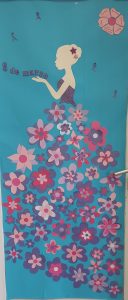
fabulous women who cooperate with all the celebrations at school, make copies, receive visitors and answer the phone. This is the decoration they made for the ‘Women’s day’ this year.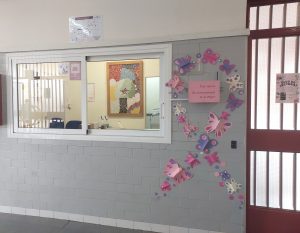
CLASSROOMS: All the classrooms have got smart screens, a computer and a whiteboard. The average number of students is between 25 and 30. Students attend most classes in them.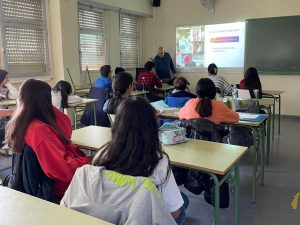
SPECIFIC CLASSROOMS AND TEACHING AREAS:
-
- ICT classroom: students go there to work with computers. Although we don’t use it much now because there are laptop trolleys that we move from classroom to classroom.
 music room: there are some instruments in it. Students learn to play the flute mainly.
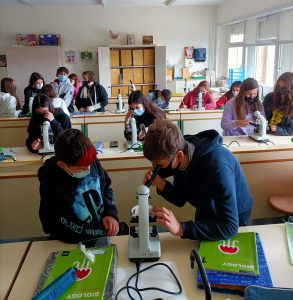
- science lab: there are practical biology classes where students see animals or plants under microscopes or dissect animals, among other things.
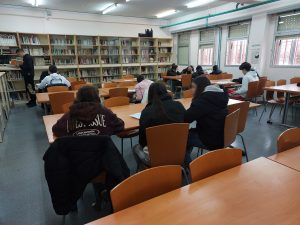
- library: students can borrow books to read at home and read or study during the break. Also, students who misbehave do the activities the teachers tell them to do here. There is a specific plan for encouraging students to read carried out by the Spanish language teachers. They take books in a trolley during the break and lend them to students for a limited period. There is a writing competition every year in which many students participate. They English Department organises a competition too.
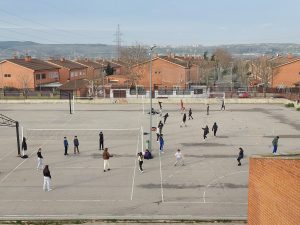
- PLAYGROUND: It is used by students during the breaks and by the Physical Education teachers as playing fields during the lessons. There are two
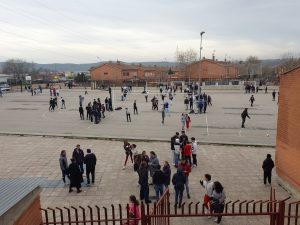 areas, one of them with two goals and another with two basketball hoops for students to play. Football is by far the most popular sport, but some students prefer basketball or volleyball. There are sometimes competitions during the break. Teachers call them ‘little leagues’ (liguillas in Spanish). There is another area
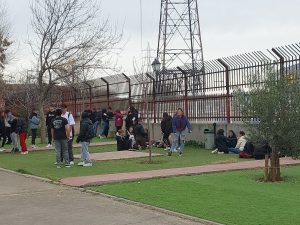 for students to sit down and eat their sandwiches and relax. There are rods to put nets to play volleyball, which some students love.
 - HALL OF SPORTS: It is very small. When two PE classes coincide, either one goes to the playground or they remain within the classrooms and teach theory.
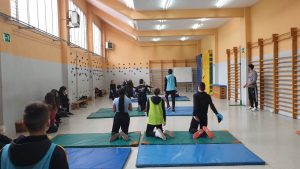 Students love sports in Mejorada, especially football. Some of them go to dancing classes in private schools or to martial arts schools in the afternoons.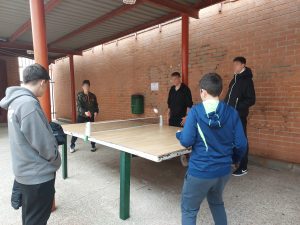
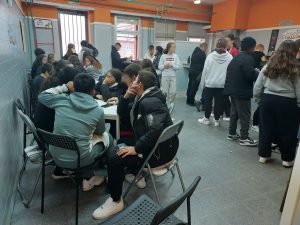
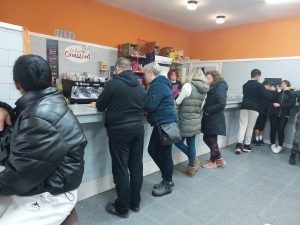
- CAFETERIA: It is a small place, like all the spaces here. It’s open from 8:20 to 3:15. We have two breaks: one from 11:10 to 11:30 and the other from 14:15 to 14:30. Students usually go there during the breaks. Sometimes they buy something on the way to their classes. In the morning, the smell of food is delicious. Some students buy snacks during the break. Some others bring sandwiches from home and eat them outside, opting for a larger lunch at home after school. Teachers go there when they have a free period and have a coffee and a snack. It is very crowded during the breaks and some students must queue to buy their snacks.
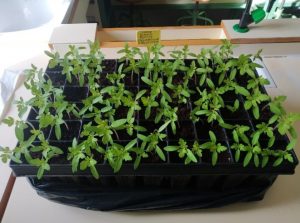
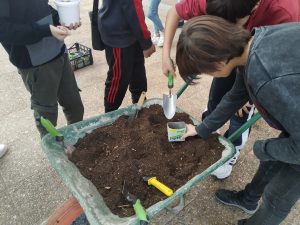
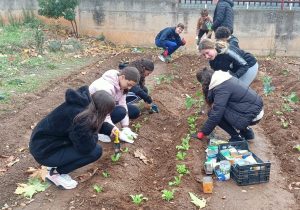
SCHOOL GARDEN: This is a Biology Department Project. Students work here with some of the subjects on a regular basis and occasionally during the biology classes. The teachers show the students to grow tomatoes, peppers, courgettes, lettuces, onions, garlic, etc. They also make compost. When the vegetables are ripe, they take them home or take them to the teachers’ staff room. We greatly enjoy eating the organic vegetables.
GREEN AREA FOR BIRDS: There is a green area with small houses for birds to nest. There is a school project for recycling paper, saving energy to support the environment. The project is called ‘Verdelibes’. You can find more information about it on our website.
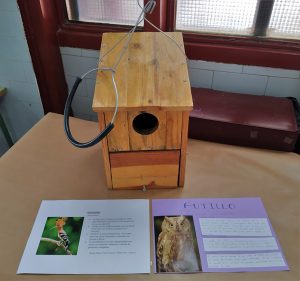
RECYCLING PROJECT: The Biology Department is in charge of a project to recycle paper in all the classrooms. There are blue containers where the students empty the small paper containers in the classrooms. Then the blue boxes are emptied into a bigger container that a company takes to a recycling station.
SMILE CLASSROOM (TEA: AUTISTIC SPECTRUM DISORDERS): We have a classroom for these specific students. Students receive support in the different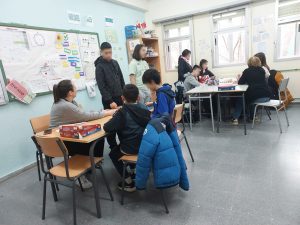 subjects in case they need it and advice in social skills. Teachers work with one or two students at a time, depending on their level. The teachers try to make them more autonomous and to build up their confidence and improve their social skills. They are in constant contact with the students’ families. There are other students who love going there during the breaks to play games and stay with their supportive teachers. They forge lifelong bonds of friendship.
HAPPY CLASSROOM: Students with curricular needs go there. Teachers help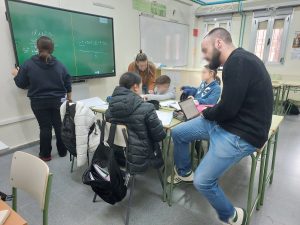 them in very small groups. They go mainly to get help in Spanish Language and maths. The teachers help other students too whenever they need it. The atmosphere is always friendly and positive towards the difficulties that may come up. Two groups of students may work at the same time. Sometimes, the teachers go into the classroom and help other students too.
COUNSELLOR’S OFFICE: The counsellor helps students in academic and personal matters. She guides and supports them working side by side with the students’ tutors and their families and acts as a career advisor.
THE REST OF THE STAFF: Depending on the needs of the students there may be a nurse. We have been lucky enough to have a nurse for the last 3 years and she helps students with physical problems, such as diabetes, anxiety problems during the exams period or occasional blackouts. There are also two people dealing with the administrative work—registering of students, organizing academic records and titles, receiving the mail that comes into the school, and keeping record of absences, among other things. The governing board of the secondary school is formed by the headmaster, two deputy headmasters and a secretary.